
Posts
-
I wrote a book.
That sentence still feels slightly surprising to type, even though the book has been finished for a few weeks now and is about to be available on Amazon. I have been writing about software development, technology policy, and the gap between how organisations think about technology and how it actually works on this blog for longer than I care to calculate. It turns out that if you write about the same cluster of ideas for long enough, from enough different angles, with enough accumulated frustration at watching the same failures repeat themselves with different names, you eventually have something that wants to be a book rather than a series of posts.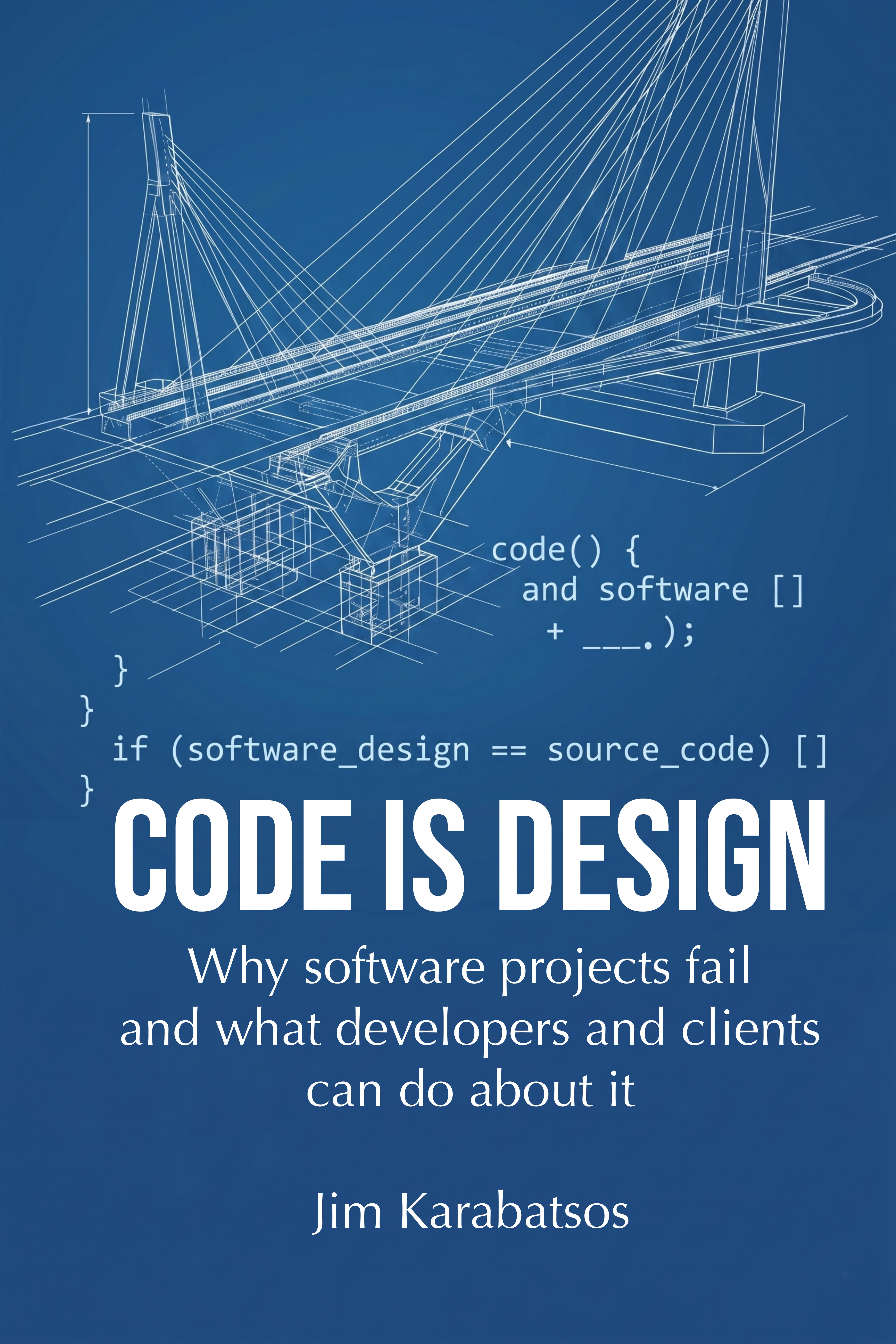 Code is Design
This is that book.
-
As the Reserve Bank of Australia signals even more interest rate increases ahead in an attempt to reign in Australia’s inflation, it is high time that we look at whether this is a reasonable strategy.
Firstly, much of the current spike in inflation is not driven by increased demand. It is clearly caused by supply-side issues: the global energy crisis caused by Russia’s attack on Ukraine, disruption (some would say collapse) of the global supply chain in the wake of Covid-19, and severe weather events largely due to global climate change. These and other factors have served to severly limit the supply of goods and services and has led to the spike in prices across the board.
-
I’ve just finished watching the news from Greece broadcast on SBS. For the best part of an hour, images were transmitted of the human suffering, the countless lives lost, the children being pulled out from under the rubble – it is just heartbreaking.
A baby born under the rubble, pulled out by rescuers who then had to cut the umbilical cord that connected the baby to its now dead mother. A small child, clutching a lock of hear in its tiny fist, presumably from its mother (but nobody knows). A child brought out who immediately said: “but I’ve got school tomorrow!”. Another small child saved, asking for his sister who was “sleeping” next to him but would not wake up – yes, she was dead. A small girl, pulled out unconscious who came to in the hospital crying for her parents; she doesn’t know that they are dead. A father, crying inconsolably and apologising to his wife because he was unable to save any of their children. People lining up, carrying the bodies of their loved ones, to get paperwork to allow them to be buried in what are essentially mass graves, laid to rest with a simple prayer because of course there is no way that the Immams can get to even a small percentage of the burials.
-
The self-styled Sultan Erdoğan has reportedly clamped down on access to social media platforms in the regions devastated by the earthquakes, thereby depriving people of pretty much the only way that they can reach out for help. This was in response to criticism of the lack of response and assistance by the Turkish government.
I really don’t want to get into politics or foreign affairs in the context of this terrible humanitarian tragedy, but I can’t help but ask: is Turkey’s military might and strategic geographical location worth the EU and USA pandering to such a horrible and morally bankrupt government? Is it not now well past high time that Turkey be ostracised from the international community until it reforms its behaviour? Yes, it will cause even more financial pain to the people, but with inflation running at over 80% pa and laws being passed and enforced for clearly political reasons, would the common people even notice a difference?
-
What a heart-breaking situation is playing out in eastern Turkey and in Syria. Two major earthquakes, 7.8 then 7.7 Richter, have caused major damage and tragically the death toll approaches 4,000 as I write this and is almost certainly going to go much higher.

Edit Wed 8, 2023: The death toll has tragcially now exceeded 7,000 people.
The images on the airwaves and the internet are heart-wrenching. Small children being rescued from under the rubble of collapsed buildings. Multi-story apartment buildings collapsing straight down, crushing and killing people in their sleep.
-
I’m finding it hard to follow the logic behind how the referendum about the indigenous voice to parliament is being handled. Now, before I am misunderstood, let me clearly state that I am absolutely in favour of providing better input into our legislature from our indigenous people. Heaven knows they have been marginalised – indeed persecuted – for far too long and it is well past time that this situation was addressed.
-
Over dinner last night, I commented about how asinine the new law passed by the Australian government was. After some time, it was clear to me that most people just don’t understand enough about how encryption works to be able to see how crazy this is, and what the negative consequences are going to be. My friends have encouraged me to explain this, in non-technical terms, and put it out there for people to see and refer to. So, here it is.
-
There’s something fundamentally broken with the whole software development industry. And no, I am not talking about the process of creating software itself. I am talking about the way we interface with the rest of the business world, the way we are perceived and the crazy expectations that are placed upon us.
If I see one more “design” that has been done by a design house, a usability consultant, or an interaction designer, I swear I will scream.
-
When I first started doing OOP, I went through far too many iterations of “Ahh, NOW I get it” only to quickly realise that I still didn’t. In many ways, it is easier to learn OOP if you have never programmed as there is less unlearning to do.
However, OOP can be very useful in attacking many types of problems so the effort involved is worthwhile. And sticktoitiveness does pay off – you will grok it in the fullness of time.
-
I’m a big fan of Ruby, the language.
I’m really impressed with the potential of the Rails framework (although to be honest there seems to be a lot of voodoo going on behind the scenes, which is probably just an indication that I have not yet done enough with this framework to be comfortable with it).
But there is no denying the reality that, for most of us, adopting Ruby and RoR is not a simple decision, because we already have code that has been developed atop a Java web stack.
-
It does not mean to be in a place where there is no noise, trouble or hard work.
It means to be in the midst of those things and still be calm in your heart.
— Anonymous
Dear God:
Help me not be a perfectionist. (Did I spell that correctly?)
Help me to relax about insignificant details, beginning tomorrow at 7:41:23 a.m. EST.
Help me to not try to run everything — but, if You need some help, please feel free to ask me.
-
… then it’s the map that is wrong.
Last week, visit this my son went for an interview for entry into one of the top academic high schools in this state and I needed to kill a couple of hours. I therefore went into a local Borders bookshop, grabbed a book almost at random and sat down with it in the embedded Gloria Jean’s with a cup of coffee. I don’t even remember the name of the book; it was something like “30 Things You Need To Know Right Now”. What has stuck in my mind is the first of these “things”.
-
Why do some people just find it hard to admit they’ve made a mistake? We all do it – heaven knows I have, on many occasions and in many contexts. Yet for some reason there are those amongst us who feel that any suggestion that they made an error needs to be shouted down forcefully, lest they be stigmatised as failures.
A mistake is not a failure. A mistake is an opportunity to learn, a chance to grow, to re-focus, to improve. It reminds us that we are not infallible, and injects a little humility into our souls.
-
I have been reading a great book over the past couple of days. It is called The Best Software Writing and I picked it up at the local Borders when I dropped in to browse as I am wont to do on the odd occasion. Reading it fired up the creative juices, so I thought I would put finger to keyboard about something that has been gnawing at me for a while now: the fact that we seem to be making things more complex than they need to be because of some misguided attempt to model the “real world”.
-
The following is a post that I made over on the Powerbasic programmer forums, hospital in response to Paul Pank’s posting asking dietary advice. Why he thought to ask about diet on a programming forum is beyond me. I have edited out the references to other posts but the entire thread can be seen at the PowerBasic Forum.
Sadly, the PowerBasic forum is now defunct so the post is no longer available
-
I just read the latest article by Joel Spolsky over on Joel on Software (a site you really should bookmark). Joel reminisces about the time he had his First BillG Interview where he had to present the spec for what was going to be Visual Basic for Applications to Bill Gates. It’s a good read and Joel’s writing style is very entertaining. While Joel and I have differing opinions on some things, I certainly respect his experience and knowledge, and I suspect that the things we disagree about are simply related to the fact that he takes some concepts too literally (especially with regards to such Agile concepts and no BDUF, but’s that’s for another post).
-
My daughter forwarded me an email just today to which she had simply added a single line at the beginning. She said:
I LOVE YOU DAD !!!
And here is the rest of the email, which she had obviously forwarded from one of her friends who had sent it to her:
When you were 8 years old, your dad handed you an ice cream.
You thanked him by dripping it all over your lap.